
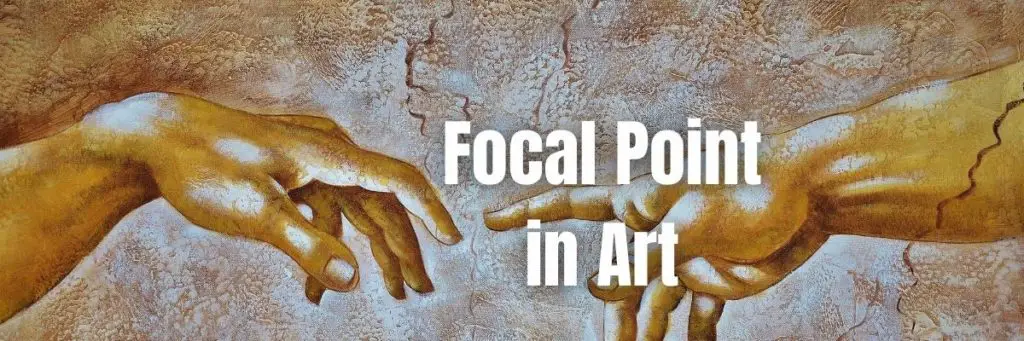
The Focal Point is the area in an artwork that immediately attracts a viewer’s eye, around which other elements in the artwork are arranged. But looking at some paintings, a viewer may struggle to find the focal point in art, and this post helps to find it.
An artist uses one or more techniques to embed focal points in his artwork, and knowing them will help you identify the focal points quickly. You can look for the following items to identify a focal point.
But first, let me brief you on what a focal point is.
Table of Contents
What is the Focal Point in Art?
A Focal Point is an area in a painting or drawing that immediately draws the viewer’s attention and guides them around the composition. Artists use this technique to lead a person’s gaze through an artwork, much like how a tour guide might lead tourists throughout a city. The Focal Point can be very obvious or subtle, depending on how it is used in the piece.
A work of art can convey emotions or even a story using a focal point.
10 Tips for Finding Focal Point in Artwork
As a viewer, the first place we see in a painting or anything with a boundary is the top left corner, and if there is nothing eye-catchy, our eyes move to the center.
Still, if we do not see anything, our eyes move to the other parts of the paintings. If you struggle to understand the artwork and have difficulty locating the focal point, the tips below can help you find it quickly.
These are not standard rules but more like tips for locating the focal point.
Look for Objects with Visual Weight:
Most artists give more visual weight to objects they wish to be noticed and less to things they don’t want to focus on. An artist may use color temperatures smartly to show visual weight.
Visual weight is an artist’s way of indicating importance.
For example, say you are looking at a painting of some fruit on top of a wooden table. The apple will probably be the heaviest item with warm color and light falling on it in the scene, and therefore most prominent.
It will help you find the focal point by looking for items with more visual weight than others. Some sub-topics will examine overlap, related or similar, but you may still use them to identify the focal point.
Look for Objects closer to you in the Paintings
Artwork is a set of objects with the appropriate background to tell a story. But closer objects appear more prominent than those away from us, which is one of the painting tips an artist uses to create the artwork’s focal point.
Equally distant objects will look more or less the same size, even if they are different sizes, if you see them from far away. The things closer to the front of the painting will have more visual weight than those further back.
You should not concentrate on all parts of the painting equally; instead, you should pay attention to the things closer to you.
So this will help you find the focal point also.
Look for Isolated Objects in the Artwork
When looking at composition, you can immediately identify the isolated objects. The artist would have placed it that way to draw your focus.
The artist tells you that this particular object, shape, or color is worth looking at carefully.
To create isolation, artists use Blur around them, Frame or Separate them from the rest.
For example, artists bring attention to an object by making it stand alone from a group, such as when one fruit sits away from a bunch of other fruits on a table.
You can find focal points by noticing the objects that break away from the group and draw your eye immediately.
Look for an area where every object Concentrate or Converge
Sometimes artists use a focal point to direct the viewer’s attention to one spot naturally.
It is beneficial when an artist wants to draw attention away from the fact he is using a technique.
An example is a man walking inside the door of a painting, and different people inside the image are looking at the new person entering.
It naturally triggers the viewer to look only at the new person entering inside first, the focal point.
The technique is called Concentration on the subject or Convergence to the subject.
Look for Elements that Draw the Eye
The one thing you should remember about focal points is that they are deliberately designed to draw your attention, even if it’s unexpectedly.
Artists place particular objects so the viewer will look at them first when they walk into the room.
An artist will do something in his painting either conceptually, visually, or through any other means that will draw the viewer’s attention.
The first thing you notice in the painting is the focal point.
Look for Objects with Stronger Composition
The focal point will always have the strongest composition of other objects inside the artwork. This vigorous composition will create visual weight.
Blending or uniform color, uniform size, or uniform length in a composition will decrease the focal power of an object. On the contrary, the thing with a warm color temperature, the center of focus, prominent and sharp, creates a more robust composition.
The focal point is that spot in a focal area where focal power reaches its most incredible intensity.
Look for Abnormal or Extraordinary items in the painting
Anything which is an abnormal item in our view will catch immediate attention. That is how the human mind is designed. We are more interested in things that are not familiar to us.
An artist may use this in his painting. And you, as a viewer, should look for those extraordinary or abnormal items which stand out and be more noticeable. So if you’re looking for a focal point, look for something unusual in the painting.
Using strange objects or techniques by the artist will catch the viewer’s immediate attention unless the viewer is not familiar with the thing or concept.
Look for Distortion or Exaggeration
The first thing we notice is an area distorted or an object exaggerated.
Distortion and exaggeration are two of artists’ most common techniques to create focal points.
When looking at a painting, look for distorted areas or objects that have been exaggerated.
An artist may exaggerate an object to draw immediate attention. Again, a viewer will naturally look at this object without spending time searching for it.
Look for Objects in Unusual Places
As a viewer of a painting, look for subject in an area that is not supposed to be. These may be usual item that needs to fall in the scene but is not supposed to be in the space.
Locating this kind of item may be a little tricky for the viewer. But the viewer should not feel discouraged as this focal point is more likely hidden.
The idea is to look at such areas and identify such focal points. But once you have located that focal point, whenever you see that painting next time, that point will be the first thing your eyes will naturally see.
The Whole Painting may be the Focal Point
Sometimes it may so happen that the whole painting becomes the focal point. It can occur when nothing in the painting stands out more than any other object.
Think about art galleries now; imagine one whole room as a canvas, and this painting may be the focal point.
This situation can be when the painting is famous or prominent, and the creator wants the viewer to see this painting.
If you enter a room and the painting is the first thing your eye catches, you can understand the painting is the focal point.
Conclusion:
The focal point will mostly have the strongest composition than other objects inside the artwork and should be the first thing you notice when looking at an object or painting.
When locating the focal points, look for something unusual to catch attention, like distortion or exaggeration, abnormalities or extraordinary items that stand out, and anything else that draws immediate attention without searching for it.
Next time you create a painting or study artwork, remember the focal point concept and how to create focal power within your art compositions.

Comments are closed.