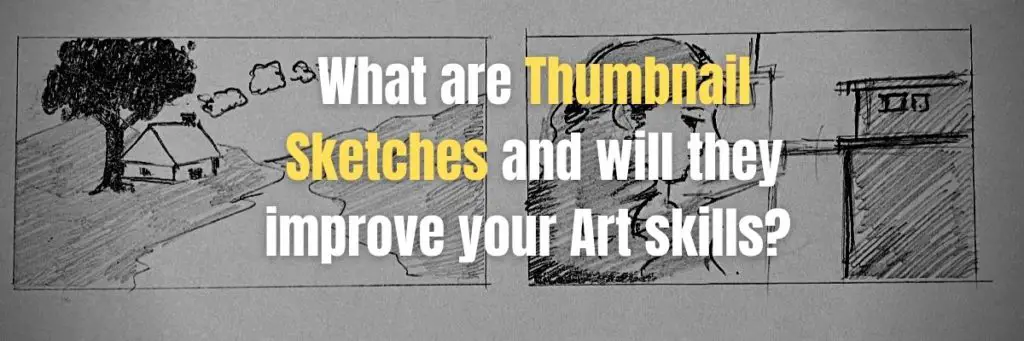
Thumbnail sketches are rough, quick, and freehand drawings drawn in smaller sizes to convey or check a visual idea. These little sketches save a lot of your time and improve your sketches to a great extent. It gives you multiple options on the composition and layout and helps you decide on the best one.
Drawing thumbnail sketches is fun; do not overthink them, and there are no rules and boundaries.
Having said that, if you take it as a part of your drawing process, it can improve your art skills tremendously.
It helps you have a structured plan in your creative process and gives you the choice and options to select the best thumbnail for further development.
It also helps you decide, change, or rearrange your subjects or objects in your composition before going ahead with your artwork.
All these pre-planning exercises help you to improve your drawing skill.
Table of Contents
What are thumbnail sketches?
Thumbnail sketches are type of drawing which are quick drawings of ideas in a miniature form, drawn roughly without any corrections to foresee the final picture.
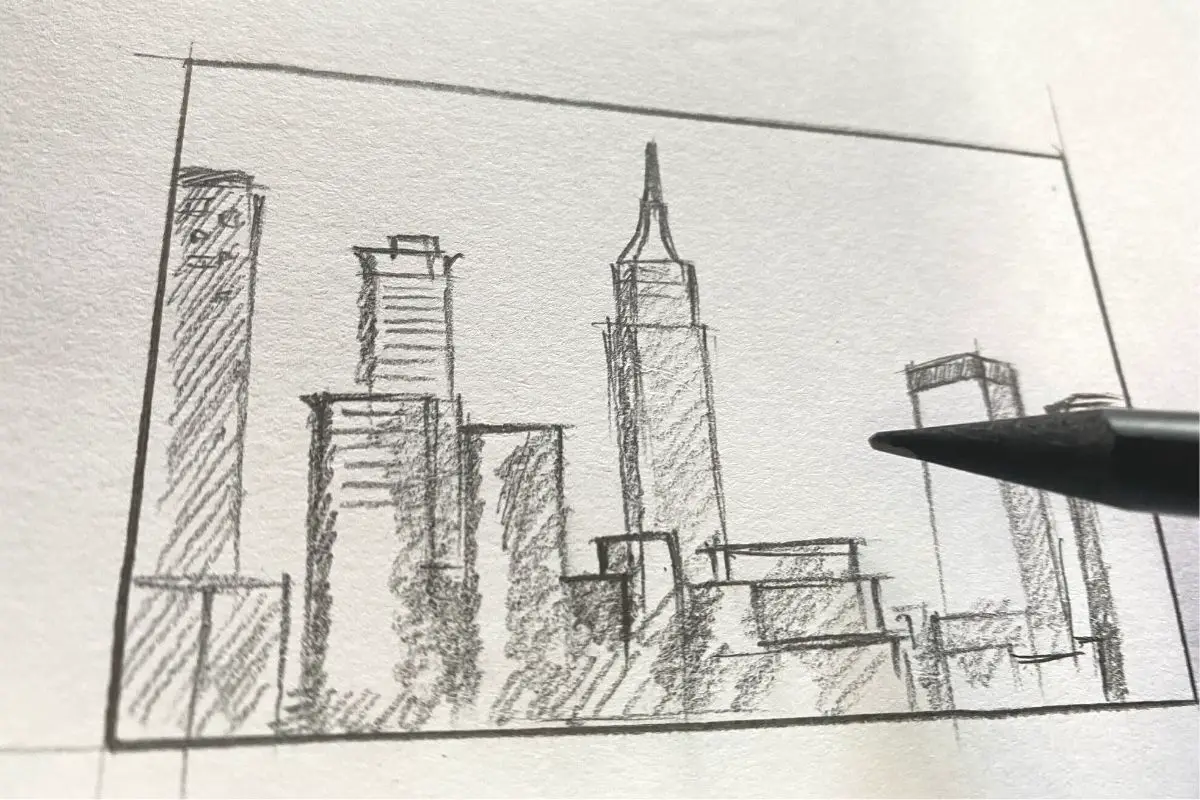
The key points to be seen here are
- Quick Drawing – You need not take too much time, and it does not require any precision when drawing. It is usually done quickly.
- Miniature Form – There are no recommended guidelines for thumbnail drawing size. They are drawn less than a credit card size.
- Rough drawing – These are rough drawings, and sometimes lines are overdrawn. The aim is to understand where you will place the subjects or objects visually and whether it is appealing.
- Correction not required – When doing thumbnail sketches, correction is not necessary unless it is for any submission. You need not use an eraser and can over-draw lines.
- Foresight into the final drawing – These sketches give you an idea of how the picture’s outcome can help you decide if you can proceed.
What are the art materials to be used for Thumbnail sketching?
Any inexpensive art materials will do. It would be best to have paper, a pencil or pen, and sometimes colored pencils and watercolors for creating thumbnails.
You can use any side of used paper, scrap paper, or newsprint paper for thumbnail sketching. You may be doing several thumbnails, which will not be preserved, and you will use the final drawing only and discard the rest.
You may use a mechanical pencil or H or BH pencil along with 4B and 6B for creating values.
Where you need an idea of color composition, you may also use colored pencils or watercolors.
If you make professional thumbnails with commercial intent for storyboarding and need to show them for approval, then I recommend using ordinary paper.
Can I use colors for thumbnail sketches?
You could, of course, add colors too to your sketches.
See, the goal of this thumbnail sketch is to confirm whether your result is going to be great visually.
If you want to validate your color composition and the diverse colors you intend to use in your drawing, you can check that on your thumbnail sketches.
This process will act as a precursor to your final drawing.
You can use colored pencils or watercolor as a medium to do this.
It needs to be rough and does not need to be elaborate. You can create multiple compositions and select the one which you want to use.
What is the size of the thumbnail sketch?
There is no mandatory or standard size for a thumbnail sketch.
Thumbnail sketches are smaller in size and should be able to fit the idea inside.
The recommended size can be about 8.5 centimeters (about the length of the long edge of a credit card) in width to 5.5 centimeters (nearly half the length of the long edge of a credit card) (almost half the height of a credit card). These dimensions are just a recommendatory size.
Even though this is a rough drawing, it is better to have them in the same size, either in a matrix or one below the other.
If you are drawing with commercial intent, it is better to draw the border of thumbnails, and the choice of printed thumbnail boxes is even better.
How long will it take to draw thumbnail sketches?
A thumbnail sketch is a simple drawing highlighting the main content inside the frame.
An artist’s time creating thumbnails depends on the type he is working on.
It may take more time if the artist creates a thumbnail in a storyboard for a motion picture.
He must visually process the situation, the subjects, and the angles and decide where to put what in every thumbnail. He may even have multiple thumbnails for the same scene.
If it is for creating an artwork, it can comparatively take lesser time. Say between 30 seconds to 10 minutes. Again, this is from my perspective. It all depends on the skill level and intent of the artists.
An artist will need more time to color his thumbnail after sketching.
Who creates thumbnail sketches?
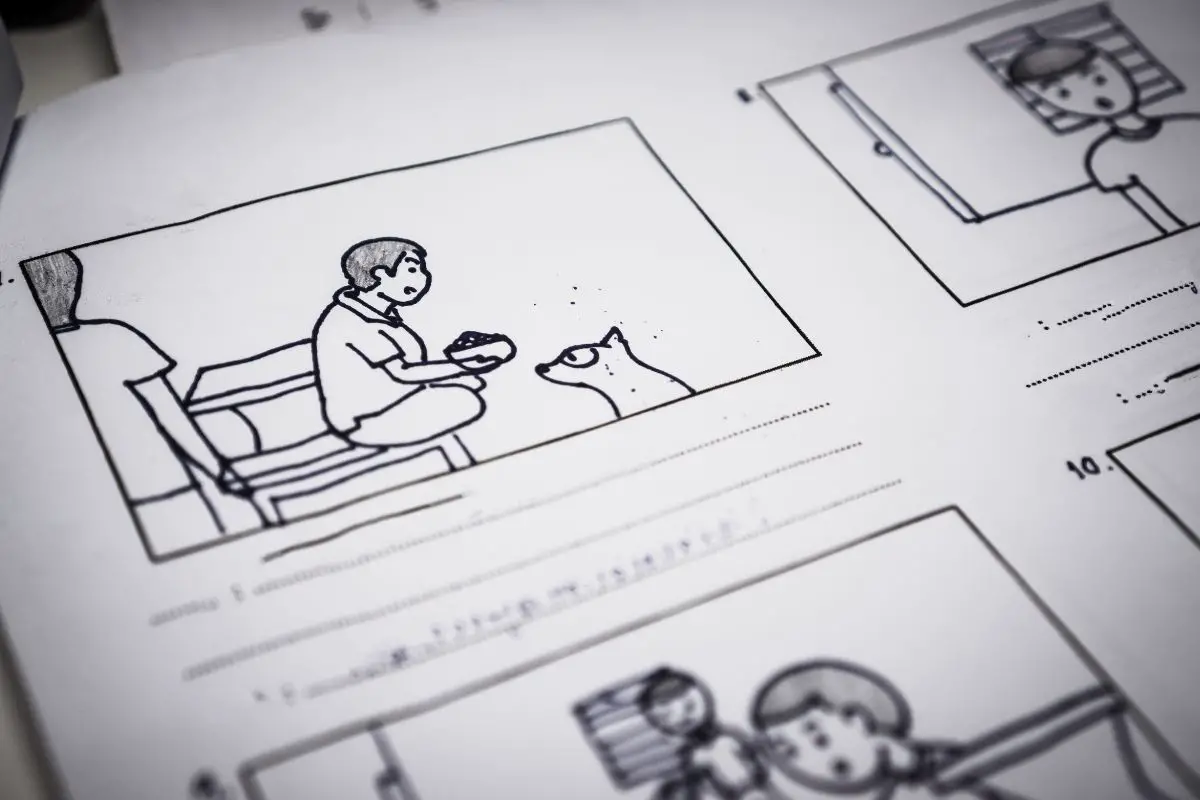
Professional artists mostly use thumbnail sketches. There are no hard-and-fast rules that amateur artists should not use.
Using it in every visual art creation is advisable, as it saves time before the final drawing.
Artists use thumbnail sketching for the following reasons: –
- Storyboard – In planning for a motion picture, animation series, etc., this thumbnail briefly helps to communicate how the images will look inside the frame visually.
- Character Designing – These drawings will also help present different characters, their specialty, what they are wearing, their mannerisms, etc., in a simple and crisp form.
- Participating in Contests – I used to do thumbnail sketches when participating in contests. I quickly draw a few illustrations in miniature size and decide with which one I should proceed. There will be a time limit, and you will be given a topic.
What should be included when creating a Thumbnail drawing?
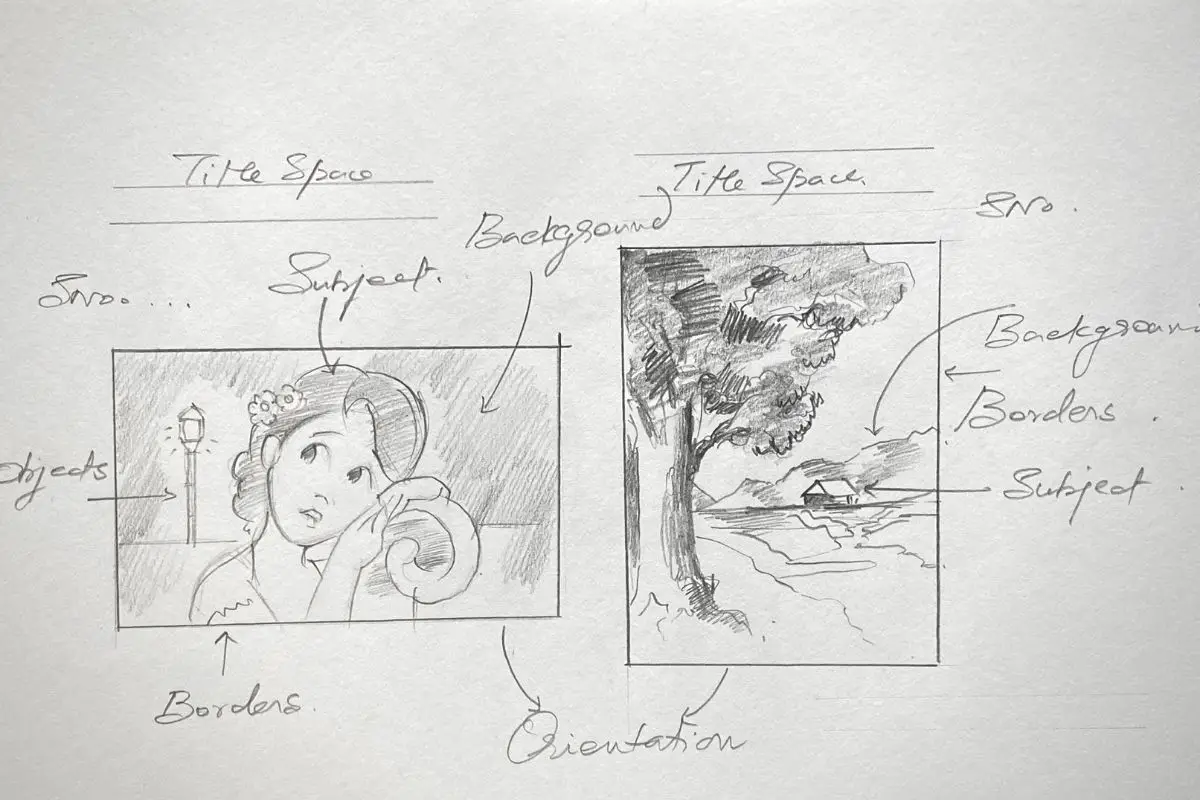
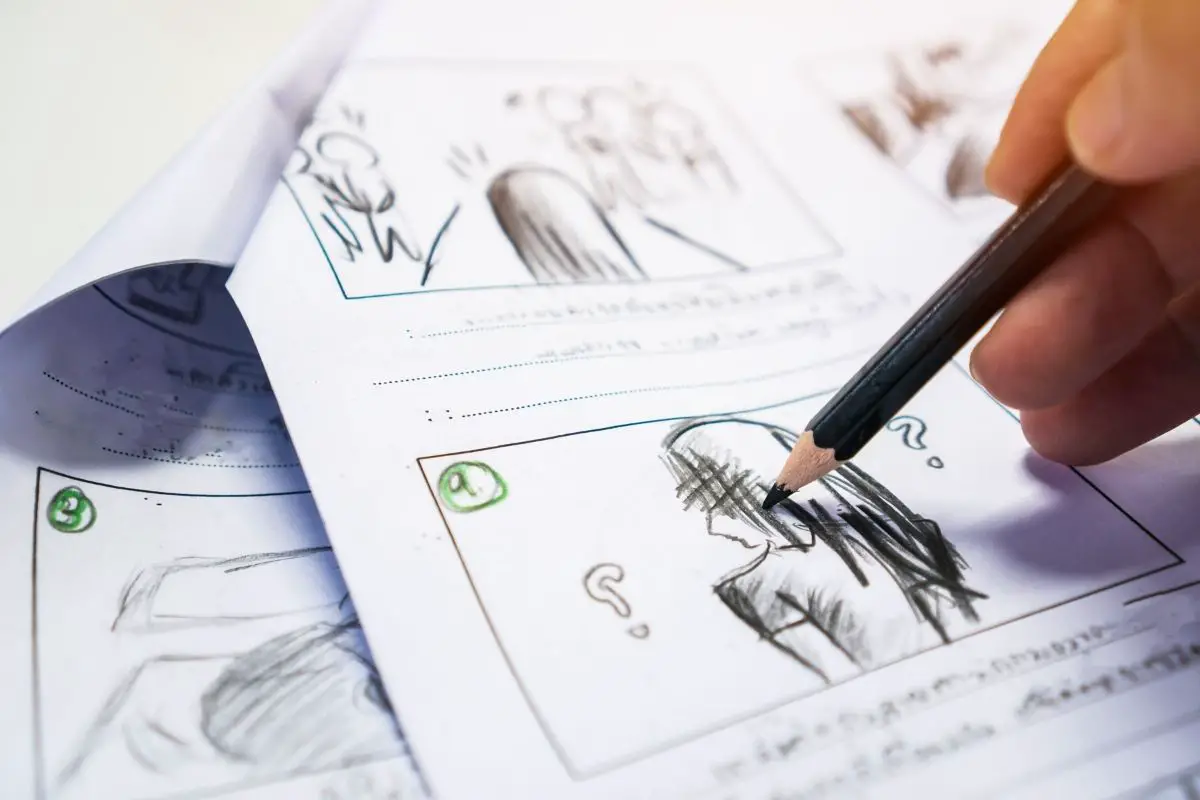
The anatomy of a Thumbnail sketch will include the following: –
- Orientation – You can do the thumbnail either in portrait or landscape mode.
- Border – It can have a border. The border defines the boundaries or the frame inside which the drawing or painting is made.
- Subjects or Objects – The drawing should have only the main topics. If two people are talking, only those two subjects are present.
- Rough Sketch – Whatever you are drawing is enough if it is a rough sketch. Also, it is not necessary to use an eraser too.
- Background – It is not mandatory, but You can also make a brief idea of the background to give an idea of the environment.
- Space for Notes – If it is a storyboard, you can keep a place for dialogue or notes on the right side of the thumbnail sketch.
- Title and serial number – If there are multiple thumbnails of the same sketch, it is advised to write a label with a serial number, which can help for future reference.
What is the primary purpose of a thumbnail sketch?
Thumbnail Sketches are a Planning Tool
A mind is a cluttered place. It is always best to put everything on paper to look clear. The same goes for artwork too. An artist can draw on paper as a thumbnail of what he has in his mind. The thumbnail can be corrected quickly and decided before drawing on canvas if the artist needs to change.
Communicates the Idea
Art is visual communication, and explaining it in words makes no sense. It is easy to draw a thumbnail and show it to the desired person before going ahead, and it will communicate what the artist intends to do and give an idea of how the drawing or painting will finally be.
Option to Select the Best
You can create multiple artwork compositions before selecting the best one. It gives you options to choose the best and weed out others. It will also offer numerous visual angles before choosing the best one. It will not take time, and you can do it quickly.
Conclusion
Thumbnail drawing is not a skill but part of your drawing process or a tool. Do not overthink about it, and let it flow freely out of you.
If you get some great idea or have seen any good picture and do not have a camera readily available, you should quickly thumbnail it and make it a habit.
As I said at the beginning of this post, creating a thumbnail is a fun process. Enjoy it when you do it.
Make sure this becomes a habit and part of your art process.
